

Round Robin Bets Explained: How Multi-Parlay Combinations Work, How Payouts Are Calculated, and When This Bet Type Is Used
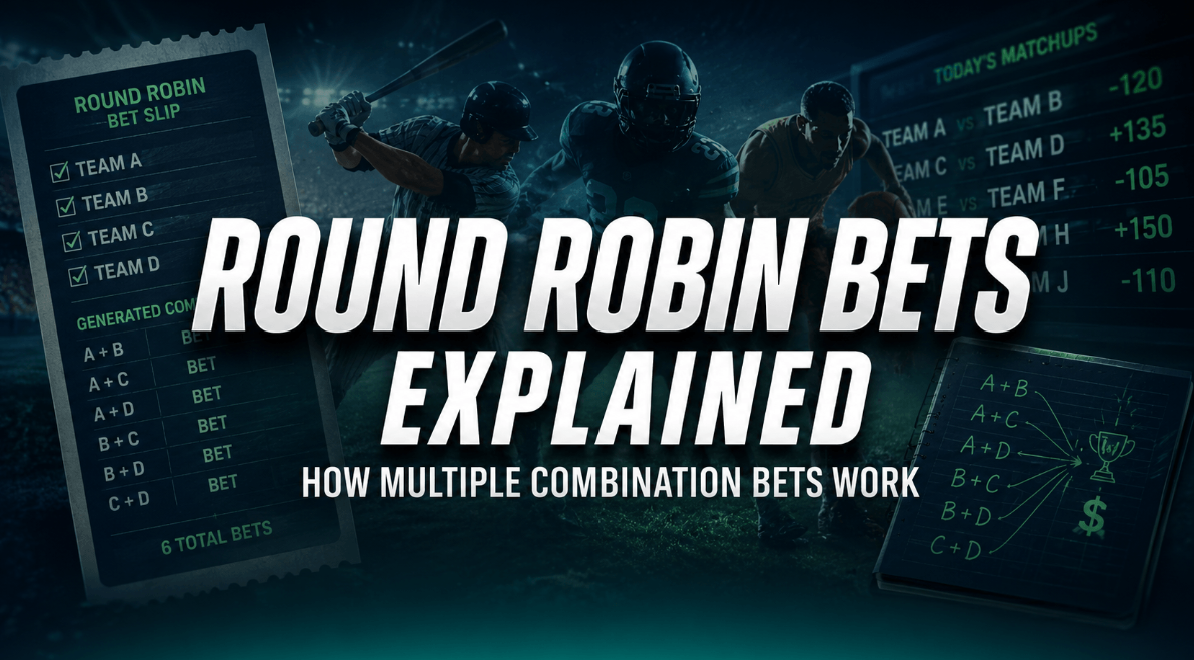
A round robin bet distributes a pool of selections across multiple smaller parlays simultaneously. Instead of combining all picks into a single all-or-nothing parlay, the round robin generates every possible sub-combination — so one losing selection doesn't void the entire wager. This article explains how round robins are constructed, how payouts work under different outcome scenarios, and what risks the format carries.
What Is a Round Robin Bet?
A round robin bet is a structured combination wager that takes a group of selections and automatically generates all possible parlays of a specified size from within that group. Each generated parlay is a separate bet, staked and settled independently.
The name comes from round-robin tournament formats in sports, where every participant plays every other participant — the same principle applies here, with every possible combination of selections being paired (or grouped) into its own parlay leg.
Example: A bettor selects three teams — A, B, and C — and chooses a two-leg round robin. The system generates three two-team parlays: A+B, A+C, and B+C. All three run simultaneously. If Team A loses, the A+B and A+C parlays lose, but B+C still has a chance to win. This partial coverage is the defining structural advantage of a round robin over a single parlay.
Most major licensed sportsbooks offer round robin betting as a structured product alongside standard parlays and teasers. For a broad range of sports and markets where round robin bets can be applied, 1xbet mobile site covers licensed betting options across football, basketball, and more.
How Round Robin Bets Differ from Standard Parlays
A parlay combines multiple selections into a single bet. All selections must win for the parlay to pay out. One losing selection voids the entire parlay — the bettor loses the full stake.
A round robin distributes the same selections across multiple smaller parlays. If one selection loses, only the parlays containing that selection are lost. Parlays that don't include the losing selection remain active and can still pay out.
The trade-off is total stake. A single three-team parlay requires one stake unit. A three-team round robin of two-leg parlays requires three stake units — one per combination. More total money is at risk, but the structure provides partial-win coverage that a single parlay cannot.
How Round Robin Combinations Are Generated
Two-Team Parlays from a Three-Selection Pool
With three selections (A, B, C) and a parlay size of two, the round robin generates every unique two-team combination:
- A + B
- A + C
- B + C
This is calculated using the combination formula: C(n, k) = n! ÷ (k! × (n−k)!)
For three selections taken two at a time: C(3,2) = 3! ÷ (2! × 1!) = 3 combinations
Step-by-step process of how a three-team round robin generates its combinations:
- Step 1: Identify the total number of selections (n = 3: Teams A, B, C)
- Step 2: Choose the parlay size (k = 2: two-leg parlays)
- Step 3: List all unique pairs — AB, AC, BC — avoiding repeats and order duplicates
- Step 4: Each pair becomes an independent parlay bet
- Step 5: Each parlay is staked separately at the per-parlay stake amount
- Step 6: Settlement: each parlay settles independently based on its own two outcomes
How the Number of Combinations Scales with More Selections
Adding more selections increases combinations rapidly. Adding a fourth selection (D) to the same two-leg round robin produces C(4,2) = 6 combinations: AB, AC, AD, BC, BD, CD. A five-selection, two-leg round robin produces C(5,2) = 10 combinations.
Choosing a larger parlay size also scales combinations. Four selections taken three at a time: C(4,3) = 4 combinations. Five selections taken three at a time: C(5,3) = 10 combinations.
Combination Count Table: Selections vs. Parlay Size
|
Selections (n) |
Parlay Size (k) |
Total Combinations |
Total Stake at $10/parlay |
|
3 |
2 |
3 |
$30 |
|
4 |
2 |
6 |
$60 |
|
4 |
3 |
4 |
$40 |
|
5 |
2 |
10 |
$100 |
|
5 |
3 |
10 |
$100 |
|
6 |
2 |
15 |
$150 |
|
6 |
3 |
20 |
$200 |
Total stake scales significantly with additional selections. A six-selection, three-leg round robin requires 20 separate $10 parlays — $200 in total exposure.
How Round Robin Payouts Are Calculated
Each parlay within a round robin calculates its payout independently: multiply the odds of each leg together, then multiply by the stake for that parlay. The total round robin return is the sum of all winning parlay payouts.
Step-by-Step Example: Three-Team Round Robin with All Winners
Setup:
- Three selections: Team A (−110), Team B (−110), Team C (−110)
- Decimal odds: −110 American = approximately 1.909 decimal
- Parlay size: 2-leg
- Combinations: A+B, A+C, B+C
- Stake per parlay: $10
- Total stake: $30
Parlay A+B: 1.909 × 1.909 = 3.644 × $10 = $36.44 Parlay A+C: 1.909 × 1.909 = 3.644 × $10 = $36.44 Parlay B+C: 1.909 × 1.909 = 3.644 × $10 = $36.44
Total return: $36.44 × 3 = $109.32 Net profit: $109.32 − $30.00 = $79.32
Step-by-Step Example: Three-Team Round Robin with One Loser
Same setup. Team C loses.
- Parlay A+B: both win → $36.44 ✓
- Parlay A+C: Team C loses → $0 ✗
- Parlay B+C: Team C loses → $0 ✗
Total return: $36.44 Net result: $36.44 − $30.00 = +$6.44 net profit
With a single parlay, losing Team C would have lost the entire stake. The round robin structure preserved a small net profit despite one losing selection.
How Partial Wins Affect Total Return
The partial win scenario is the core value proposition of round robin betting. The exact outcome depends on which and how many selections lose. Losing a selection that appears in the fewest combinations has the least impact; losing a high-odds selection that appeared in winning parlays costs more than losing a low-odds selection.
|
Scenario |
Winning Parlays |
Losing Parlays |
Total Return |
Net Profit/Loss |
|
All 3 win (A+B+C) |
3 of 3 |
0 |
$109.32 |
+$79.32 |
|
One loss (C loses) |
1 of 3 (A+B) |
2 of 3 |
$36.44 |
+$6.44 |
|
Two losses (B and C lose) |
0 of 3 |
3 of 3 |
$0 |
−$30.00 |
|
All 3 lose |
0 of 3 |
3 of 3 |
$0 |
−$30.00 |
Based on $10 per parlay, three selections at −110 each (decimal 1.909), three-team two-leg round robin.
Round Robin Bet Types by Parlay Size
Two-Leg Round Robin
The most common format. Every possible two-selection parlay is generated from the full pool. With three selections this produces 3 parlays; with four selections, 6 parlays. Two-leg round robins provide the broadest partial-win coverage because two losses are required to eliminate all parlays only when the same two teams happen to appear in no surviving combinations.
Three-Leg Round Robin
Requires a minimum of four selections to generate more than one combination (C(4,3) = 4). Three-leg parlays carry higher variance and larger payout potential per winning combination but are more sensitive to losing selections since each loss eliminates more combinations simultaneously.
Mixed Parlay Size Round Robins
Some bookmakers offer round robins that simultaneously generate combinations at multiple parlay sizes — for example, all two-leg and all three-leg parlays from a four-selection pool. This produces C(4,2) + C(4,3) = 6 + 4 = 10 total parlays and increases total stake and coverage simultaneously.
Stake Allocation in Round Robin Bets
Per-Parlay Staking vs. Total Stake Distribution
Bookmakers handle stake allocation in two ways. In per-parlay staking, the bettor sets a fixed stake for each individual parlay (e.g., $10 per combination). Total exposure is: number of combinations × stake per combination.
In total stake distribution, the bettor sets a total budget (e.g., $30) and the sportsbook divides it equally across all combinations ($10 per combination for a three-combination round robin). Both methods produce the same per-parlay stake when the numbers align, but the framing differs by platform.
How Total Exposure Is Calculated
Total exposure = Number of combinations × Stake per parlay
This is the maximum amount at risk. Unlike a single parlay where one stake is at risk, a round robin commits separate stakes to each combination. A bettor who treats a round robin as "equivalent to one parlay" is underestimating their total financial exposure.
A six-selection, two-leg round robin at $10 per parlay commits $150 total — 15 times the cost of a single two-leg parlay at $10. The coverage is broader, but the investment is substantially larger.
Round Robin vs. Parlay vs. Teaser: Full Comparison Table
|
Feature |
Round Robin |
Standard Parlay |
Teaser Bet |
|
Combination structure |
Multiple sub-parlays from all possible groupings |
Single combination — all selections in one bet |
Single combination with adjusted lines |
|
Partial win possible |
Yes — surviving parlays pay out independently |
No — one loss voids entire bet |
No — one loss voids entire teaser |
|
Stake per leg |
One stake per combination generated |
One total stake |
One total stake |
|
Payout on full win |
Sum of all winning parlay payouts |
Single parlay payout |
Reduced payout due to line adjustment |
|
Payout on one loss |
Surviving parlays still pay |
Zero |
Zero |
|
Bookmaker availability |
Most major sportsbooks |
Universal |
Most major sportsbooks |
|
Minimum selections |
3 (for 2-leg round robin) |
2 |
2 |
|
Total exposure |
High — scales with combinations |
Low — single stake |
Low — single stake |
Sports and Markets Where Round Robin Bets Are Most Common
Round robin bets are available across most major sports at sportsbooks that offer parlay betting. NFL and NBA are the most common application sports — their large number of weekly games and standard spread/moneyline markets make them natural candidates for combination betting.
College football and college basketball are also frequently used for round robins, given the volume of games per week and the number of available selection pools. Round robins on player props — individual player performance markets — are available at some bookmakers, though market availability varies.
Soccer round robins are less common in North American sportsbook formats but are structurally equivalent to accumulator hedging strategies used in European betting markets, where bettors combine multiple match selections across different leagues.
How Bookmakers Handle Void Legs in Round Robin Bets
A void leg occurs when one of the selections in a round robin is cancelled — typically because a game is postponed, a player market is withdrawn, or a specific settlement condition is not met. Void leg handling in round robins varies by bookmaker.
The standard approach: a voided selection is removed from each parlay that contained it, and that parlay is recalculated as if it contained one fewer leg. A two-leg parlay containing a voided selection becomes a single-leg bet at the remaining selection's odds. If the remaining selection wins, the parlay pays out at single-leg odds.
Some bookmakers settle voided legs as a push (return of stake) rather than reducing the parlay. In this case, the round robin structure is preserved but each affected parlay pays out slightly less because one leg's multiplier is removed.
Bettors should confirm their sportsbook's void leg policy before placing round robins, particularly when including markets susceptible to late cancellations (player props, weather-affected outdoor events).
Limitations and Risks of Round Robin Betting
Key risks and limitations of round robin betting compared to single parlays:
- Higher total stake exposure: round robins multiply the per-parlay stake by the number of combinations. A bettor used to single-parlay risk may underestimate total capital committed.
- Lower payout per unit staked than a single parlay: because the stake is spread across multiple combinations rather than compounding on one, the return on a successful round robin is lower per dollar risked than a single parlay covering the same selections.
- Partial wins don't always produce net profit: losing two selections in a three-selection round robin eliminates all parlays and returns nothing — the same outcome as a failed single parlay, but with a higher total stake.
- Complexity in stake management: tracking exposure across multiple simultaneous parlays requires more attention than a single bet, particularly when mixing parlay sizes.
- Availability varies by bookmaker: not all sportsbooks offer round robin betting as a structured product. Some require manual construction of each combination as separate parlay bets.
- Void leg handling differences: platform-specific rules for voided selections can produce unexpected settlement outcomes if not checked in advance.
FAQ
Q: How many parlays does a four-selection, two-leg round robin generate?
C(4,2) = 6 parlays. The four selections (A, B, C, D) produce: AB, AC, AD, BC, BD, CD. Each is a separate two-team parlay staked and settled independently.
Q: Can I lose money on a round robin even if most selections win?
Yes. If two selections lose in a three-selection round robin, all three parlays fail — since each parlay includes at least one of the two losing selections. The full stake across all three parlays is lost. Partial protection only works if no more than one selection loses (in a three-team, two-leg round robin structure).
Q: Is the total payout of a round robin higher or lower than a single parlay covering the same selections?
Lower per dollar staked. A single three-team parlay at $10 pays the full compounded odds of all three teams on one $10 stake. A round robin generates three two-team parlays at $30 total — each parlay pays compounded two-team odds on $10. The single parlay offers higher leverage; the round robin offers partial-win protection at a higher total cost.
Q: How does a voided leg affect my round robin?
The void leg is typically removed from each parlay containing it. A two-leg parlay drops to a single-leg bet; a three-leg parlay drops to a two-leg parlay. Settlement proceeds at the reduced parlay odds. Some sportsbooks handle voids as a push (stake return) rather than a reduction — check platform-specific terms.
Q: What is the minimum number of selections needed for a round robin?
Three selections for a two-leg round robin (producing 3 combinations). Four selections for a three-leg round robin (producing 4 combinations). With only two selections, a round robin produces one combination — equivalent to a single parlay.
Q: Are round robins available in-play (live betting)?
This depends on the bookmaker. Some sportsbooks allow in-play parlay construction, which can include round robin formatting if the platform supports it. Most structured round robin products are offered for pre-match markets. In-play availability is not universal.
Q: Is a round robin the same as a patent or Trixie bet?
These are related but not identical. A Trixie covers three selections with three two-leg parlays and one three-leg parlay — equivalent to a three-selection round robin at two-leg size plus one additional three-team parlay. A Patent adds three single bets to the Trixie structure. Round robins, as offered by North American sportsbooks, typically refer to the combination parlays only, without added singles or full-combination accumulators. European-style system bets (Trixie, Patent, Yankee, Lucky 15) follow the same underlying combinatorics but include more bet types per structure.